1. Snorkeling in a lagoon, on a golf course beside a giant pig barn, searching for lost golf balls, because each ball is worth 75 cents.
It’s a recession you know.
2. Petting a dolphin at a roadside aquarium in Florida during the Gulf War.
The dolphin, being a bit bruised and claustrophobic, acted harshly and somewhat violent with its oppressors.
3. Poolside at the condo, a boy flew his toy airplane off a 4th floor balcony right into my brother’s face. He proceeded to apologize with great intent. Luckily no damage done.
4. In the arcade, underneath the tower, we tried so desperately to grab a stupid toy with a fumbling robotic arm. We must have pumped a hundred quarters into that machine; it was either that or shuffleboard with the old folks.
5. Sitting in a car, in mediocre weather, watching the mammoth highway signs go by, and drawing pictures on the foggy backseat window, it all made sense in my head.
It’s a recession you know.
Tuesday, April 14, 2009

Friday, April 10, 2009
The straight and winding road to Nirvana
Surfing the yin yang on a board of alcoholic contemplation
To the shores of utter disappointment
Only to be chased further by
Nihilistic visions over two city blocks on a unicycle
Makes one happy to wake up sweaty
Thus realizing that it was all a bittersweet dream
And coffee never tasted so good
After nights spent soaked in
The perspiration of chasing God
To the shores of utter disappointment
Only to be chased further by
Nihilistic visions over two city blocks on a unicycle
Makes one happy to wake up sweaty
Thus realizing that it was all a bittersweet dream
And coffee never tasted so good
After nights spent soaked in
The perspiration of chasing God
Tuesday, April 7, 2009
i am still
Lately, I have been reflecting on why people so often answer the question, “How are you?” with “I’m busy”. Is busyness really the reality of that many people’s lives? Is it more socially acceptable to say “I’m busy” than to answer “There’s not much going on”? Or, is this common response just a habit? I think all of these reasons apply.
As someone who often feels “busy”, I have come to the realization that it is often the high expectations I put on myself that keep me in a constant state of “busyness”. I often feel busy, but I can also choose to do things differently to reduce the stress in my life.
In some ways, we can all become prisoners of our own mindsets. Is it really necessary to be so busy all the time? Perhaps, if we didn’t want so much we wouldn’t be so busy. Of course, I am aware that everyone has responsibilities and commitments. However, there are always choices about what we do. Do we want too much? Are we trying to do too much? What is all the anxiety about?
Over one million people in Canada suffer from depression and anxiety. One of the factors that exacerbate both psychiatric disorders is the fast pace of today’s lifestyles. This is compounded when we also hold high expectations of ourselves because we tend to overload our schedules with all the things we think we “should” do. And, if we don’t do them, we may end up feeling guilty. What an endless negative cycle to put yourself through!
We may be trying to be the ideal parent, the outstanding employee, the perfect partner, or the inexhaustibly caring friend. Inevitably, we cannot continue to do everything these roles may demand. Overwhelming ourselves with too many activities can actually prevent us from doing anything well.
The quality of what we can give suffers when we demand too much of ourselves. The way in which we give or do something can make all the difference, for both the giver and the receiver. If we can genuinely share a part of ourselves for a few minutes with someone else, both people can feel a deeper sense of satisfaction and understanding in the connection. Simply put, it feels good. The giver can feel good about sharing authentically, and the receiver will pick up the fact that the other person is present and feel valued.
We can help ourselves develop more realistic expectations of ourselves by:
* being compassionate, gentle, and fair with ourselves,
* saying no when we need to,
* placing some limits on our time,
* consciously choosing our priorities, and
* spending time with the people we truly care about (not with people who drain us).
Through listening to ourselves, we can be truly present to others and enjoy their company. By not overloading ourselves with activities and responsibilities, we can find deeper satisfaction in the experiences we do have. Moreover, we can find a fuller life in a simplified one. So, the next time someone asks you how you are, why not say “I am still”, and listen to the other person? While experiencing your own centredness, it just might feel so good that you will want to do it again.
Suzanne Welstead
April 2009
---
above is the "thought of the month" from one of my personal mentors. i am currently in the process of reading her first book, Searching for You: Ideas about Healthy Relationships, and i am finding so many "ah-ha" moments. if you appreciate reading the narrative of another person's realisations, then i would recommend this book to you. even if you're in healthy relationships, consider this a good reminder of the things you may forget from day to day.
As someone who often feels “busy”, I have come to the realization that it is often the high expectations I put on myself that keep me in a constant state of “busyness”. I often feel busy, but I can also choose to do things differently to reduce the stress in my life.
In some ways, we can all become prisoners of our own mindsets. Is it really necessary to be so busy all the time? Perhaps, if we didn’t want so much we wouldn’t be so busy. Of course, I am aware that everyone has responsibilities and commitments. However, there are always choices about what we do. Do we want too much? Are we trying to do too much? What is all the anxiety about?
Over one million people in Canada suffer from depression and anxiety. One of the factors that exacerbate both psychiatric disorders is the fast pace of today’s lifestyles. This is compounded when we also hold high expectations of ourselves because we tend to overload our schedules with all the things we think we “should” do. And, if we don’t do them, we may end up feeling guilty. What an endless negative cycle to put yourself through!
We may be trying to be the ideal parent, the outstanding employee, the perfect partner, or the inexhaustibly caring friend. Inevitably, we cannot continue to do everything these roles may demand. Overwhelming ourselves with too many activities can actually prevent us from doing anything well.
The quality of what we can give suffers when we demand too much of ourselves. The way in which we give or do something can make all the difference, for both the giver and the receiver. If we can genuinely share a part of ourselves for a few minutes with someone else, both people can feel a deeper sense of satisfaction and understanding in the connection. Simply put, it feels good. The giver can feel good about sharing authentically, and the receiver will pick up the fact that the other person is present and feel valued.
We can help ourselves develop more realistic expectations of ourselves by:
* being compassionate, gentle, and fair with ourselves,
* saying no when we need to,
* placing some limits on our time,
* consciously choosing our priorities, and
* spending time with the people we truly care about (not with people who drain us).
Through listening to ourselves, we can be truly present to others and enjoy their company. By not overloading ourselves with activities and responsibilities, we can find deeper satisfaction in the experiences we do have. Moreover, we can find a fuller life in a simplified one. So, the next time someone asks you how you are, why not say “I am still”, and listen to the other person? While experiencing your own centredness, it just might feel so good that you will want to do it again.
Suzanne Welstead
April 2009
---
above is the "thought of the month" from one of my personal mentors. i am currently in the process of reading her first book, Searching for You: Ideas about Healthy Relationships, and i am finding so many "ah-ha" moments. if you appreciate reading the narrative of another person's realisations, then i would recommend this book to you. even if you're in healthy relationships, consider this a good reminder of the things you may forget from day to day.
Sunday, March 29, 2009

Friday, March 27, 2009
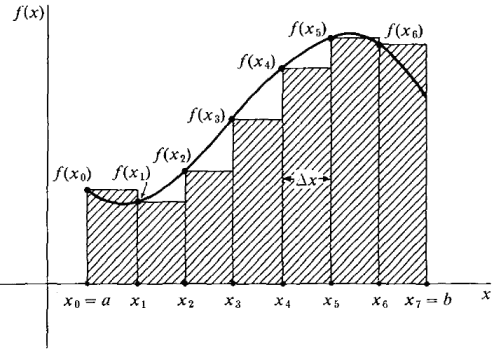
When thinking about just about anything that lies on a dimension, it is natural for me to play a little game and imagine what lies at the poles. Personality traits are often thought of as dimensions. It’s advantageous to imagine the manifestations of the ‘most,’ or the ‘least’ of some particular trait, because those images become prototypes, and all that lies between them are transformations.
When I encountered the trait self-complexity, I automatically played my little game. What would someone be like who had infinite self-complexity? It’s impossible, we might say. However, in doing calculus it is. For example, we can examine the equation y = 1\x as x approaches infinity, but we cannot look at the end-point, because it isn’t real. (neither is the point where x approaches 0). If we do the calculus for self-complexity, we find someone(s) who have identities wrapped up in increasingly higher numbers of aspects. Such persons would, by the extrapolations of evidence given in the textbook, be very resistant to stress, at least those caused by perceived social impacts, (Not those stressors that harm the body). Furthermore, such persons would be less prone to mood swings, and particular positive or negative information about them would have less of an impact on their perceived self.
It’s a fun game to play to imagine such a person, or to imagine achieving such a state. I am not sure that many people would trade the mix of happy and sad moods for a more gentle ride. It’s not even possible, is it? It would be a ridiculous enterprise to describe oneself via a humongously intricate personality profile, a task demanding enough to be exhausting on a day-to-day basis. But if we look at the calculus, we see that as the number of personality aspects increases, assuming the there is a finite amount of information to describe, those aspects get more and more specific. And, as the number of aspects approaches infinity, the specificity, or the size of the aspect approaches 0.
There are a number of ways to increase the specificity of our self-descriptions, across dimensions, or within time. If we look at time as our variable (let x be time), then the second last hypothetical individual (lets call him infinite self-complexity minus 1), would be defining themselves moment to moment, and I imagine they would be very frustrated with the whole task. What would the next person do? The last hypothetical person, the one with infinite self-complexity, would just stop defining themselves entirely. Of course this person would appear similar to someone with 0 self-complexity. The head of the process would swing right around and bite itself in the tail. Didn’t someone say, that true knowing, is knowing that you know nothing?
 Interestingly there is another form of calculus that allows us to find the area of non-rectangular items. Imagine a curve on an x-y plot. We can find an estimate of the area of that irregular shape by inserting and adding up the area of a number of rectangles. However it’s an estimate because of the overlaps, and the the missing bits. But we can decrease the overlap and the missing bits by increasing the number of rectangles. The true area would be what we would find inserting an infinite number of rectangles. Of course we can’t do that, but we can find the limit to the area as we approach infinity, which gives us a pretty good answer. This might form a good analogy for increasing self-complexity across dimensions. We can see ourselves more accuratly, if we look at increasingly numerous numbers of concepts, but we lose power to grasp that concept as it gets more and more specific, and less observable.
Of course, this little game assumes that the self is finite in the first place, in which case if it isn’t, the whole process is futility ab initio.
Friday, March 20, 2009
what language are you speaking
words, words, words. our language is what has defined our entire state of being. when did we get here? how did we allow this to happen? a number of examples come to mind of how language has limited our experience of the world and ourselves. more importantly ourselves. how could anyone possibly find the articulation to encompass the indescribable? these letters, these symbols, are too small to be used in understanding the meaning of "is".
i came across a video of a young guy talking about embodiment and representation. first of all, it made me long for people that i used to have really mind-numbing conversations with. mind-numbing in the sense that i always found myself getting caught up in the unimaginable, like trying to comprehend the size of the universe. secondly, i found it very comforting to hear that some stranger, somewhere in this world, has had similar questions.
with an impending transition, i've been experiencing a number of emotions. but, when i try to share them with people i cannot quite explain what is going on inside. it gets frustrating because they can't exactly know the balance between excitement and fear, the ratio between joy and anxiety. sometimes i wish i could just touch someone so that they could hear my inner thoughts, and know that silent monologue. but, instead i've had to try to verbalise these things, and without consciously doing it i categorise and label.
in the video, the guy says: all of our thought activity is a function of the way our brains are structured rather than the way the objective world is structured... language is part of our experience, but language is essentially a biological activity. it isn't an objective representation of the world. we can't logically picture reality with human language. like vichenstein said, 'the meaning of a word is the way that it's used in a particular social context. it has no independent meaning in and of itself but within that context'.
this makes me wonder about how we must, every day, somewhat revert to those social transgressions, if i may. that we knowingly restrict ourselves by continuing to encase our experience with the meanings that have been taught to us. i even think it applies to both ends of the spectrum in terms of personal experience. my sister is going through a terrible personal struggle. with the suicidal death of one of her friends she has spun into questioning her own mortality, her ideas about existence, and her understanding of herself as a part of the universe. i know it scares her, but rather than allowing herself to be inside of those feelings she falls back on social constructs of acceptable thoughts and behaviours. apparently she cannot be sad because she has everything that should make her happy. she doesn't think that she's allowed to feel negative because there is someone else who must live with much less than she has. to be fair, sometimes it is good to be reminded that living in canada is a blessing in many ways, and that most of us do have a warm home, an education or opportunities for self-fulfillment, and people that we know and care about. we can easily find ourselves taking those things for granted. but, i don't think it is right that she doesn't give herself the permission to experience the world uniquely.
on the other hand, i also wonder about the l-word. love. so many definitions. but, do we limit our experience of love by using words? in my experience, when you meet someone and grow to love them, you understand that love before your mind thinks it. but, within our society and these constantly changing cultural norms (or abnorms), the labeling of these feelings tends to precede the innate understanding. and sometimes, we claim a love that we never feel at all. why? what do we achieve? do we "fit in"? i would much rather go my entire life in the company of a man who never told me he loved me, but showed me, than hear "i love you" and never truly believe it.
i came across a video of a young guy talking about embodiment and representation. first of all, it made me long for people that i used to have really mind-numbing conversations with. mind-numbing in the sense that i always found myself getting caught up in the unimaginable, like trying to comprehend the size of the universe. secondly, i found it very comforting to hear that some stranger, somewhere in this world, has had similar questions.
with an impending transition, i've been experiencing a number of emotions. but, when i try to share them with people i cannot quite explain what is going on inside. it gets frustrating because they can't exactly know the balance between excitement and fear, the ratio between joy and anxiety. sometimes i wish i could just touch someone so that they could hear my inner thoughts, and know that silent monologue. but, instead i've had to try to verbalise these things, and without consciously doing it i categorise and label.
in the video, the guy says: all of our thought activity is a function of the way our brains are structured rather than the way the objective world is structured... language is part of our experience, but language is essentially a biological activity. it isn't an objective representation of the world. we can't logically picture reality with human language. like vichenstein said, 'the meaning of a word is the way that it's used in a particular social context. it has no independent meaning in and of itself but within that context'.
this makes me wonder about how we must, every day, somewhat revert to those social transgressions, if i may. that we knowingly restrict ourselves by continuing to encase our experience with the meanings that have been taught to us. i even think it applies to both ends of the spectrum in terms of personal experience. my sister is going through a terrible personal struggle. with the suicidal death of one of her friends she has spun into questioning her own mortality, her ideas about existence, and her understanding of herself as a part of the universe. i know it scares her, but rather than allowing herself to be inside of those feelings she falls back on social constructs of acceptable thoughts and behaviours. apparently she cannot be sad because she has everything that should make her happy. she doesn't think that she's allowed to feel negative because there is someone else who must live with much less than she has. to be fair, sometimes it is good to be reminded that living in canada is a blessing in many ways, and that most of us do have a warm home, an education or opportunities for self-fulfillment, and people that we know and care about. we can easily find ourselves taking those things for granted. but, i don't think it is right that she doesn't give herself the permission to experience the world uniquely.
on the other hand, i also wonder about the l-word. love. so many definitions. but, do we limit our experience of love by using words? in my experience, when you meet someone and grow to love them, you understand that love before your mind thinks it. but, within our society and these constantly changing cultural norms (or abnorms), the labeling of these feelings tends to precede the innate understanding. and sometimes, we claim a love that we never feel at all. why? what do we achieve? do we "fit in"? i would much rather go my entire life in the company of a man who never told me he loved me, but showed me, than hear "i love you" and never truly believe it.
Tuesday, March 17, 2009
Sodium Anger Supressants
Harvesting an empire go the horses plowing salt beneath the sovereign fields of lore that once produced the finest malt from which ironically the crown exacted tribute to acquire all the horses now employed in pulling horses from the mire
The empire can’t let you become angry, for if you do, you will likely be compelled to act. An active citizenry is detrimental to the pyramidal power structure of the empire. This is why Emperor Obama has recently changed his tone back to one of hope again, hope that by downplaying the new depression we’re all witnessing, things will somehow just get better. Highlighting the bitterness of the new struggle is too real for many Americans. They like the old Obama better, the one at the forefront of some mythical renaissance about to envelop their great land. They like hearing songs about better times beyond George Bush, not speeches about how much money will be required to bail out the large handful of corrupt and teetering Wall Street financial institutions whose vaults were recently revealed to contain nothing more than a few crumpled, yellowed news pages from the Wall Street Journal.
The world’s most powerful banks are falling faster than the speed with which they swindled that cool ten trillion dollars from the lifetime savings of the working and middle classes. This is why we aren’t supposed to be angry, just utterly confused. If we don’t understand the technically incoherent Wall Street lingo, we certainly can’t come to explain how our retirement savings can disappear overnight, or how corporate bankruptcy protections enacted to save a company’s upper echelons can also terminate the majority of the workforce, immediately. If an ordinary citizen could properly do the math and explain in numbers how top corporate executives are able to garner hefty bonuses before stepping into the cockpits of other industries to garnish workers wages, they’d most certainly see before them the highway robbing bankers sanctimoniously wrapping themselves in ambiguous pages of obscure law.
If one hasn’t the vocabulary with which to define oppression, one cannot know that they are a slave. If this is the current state of the union, it is because Americans have been kept fat and satiated at home watching their television sets on pharmaceutical drugs, or otherwise tied up at work sitting through extended, unpaid overtime hours pushing pages through a computer. These corporate bailout shenanigans should have so boldly spurned the people of the United States that it’s a wonder we aren’t seeing pitchforks at the doors of Capitol Hill, especially in the hands of those Americans about to foreclose on homes purchased through predatory lending tactics. Instead, we see Barrack Obama coming to the rescue on TV with his futile government order to stop AIG executives from receiving bonuses they are legally allowed to receive. Everything is okay. You can go back to comfortably watching John Stewart laugh his way through this global financial crisis tonight because, realistically, any anger needed to topple this brutal empire should have been expressed throughout the last eight years of rule. We’re now in the house that complacency built, where the walls are transparent but nobody is looking.
The empire can’t let you become angry, for if you do, you will likely be compelled to act. An active citizenry is detrimental to the pyramidal power structure of the empire. This is why Emperor Obama has recently changed his tone back to one of hope again, hope that by downplaying the new depression we’re all witnessing, things will somehow just get better. Highlighting the bitterness of the new struggle is too real for many Americans. They like the old Obama better, the one at the forefront of some mythical renaissance about to envelop their great land. They like hearing songs about better times beyond George Bush, not speeches about how much money will be required to bail out the large handful of corrupt and teetering Wall Street financial institutions whose vaults were recently revealed to contain nothing more than a few crumpled, yellowed news pages from the Wall Street Journal.
The world’s most powerful banks are falling faster than the speed with which they swindled that cool ten trillion dollars from the lifetime savings of the working and middle classes. This is why we aren’t supposed to be angry, just utterly confused. If we don’t understand the technically incoherent Wall Street lingo, we certainly can’t come to explain how our retirement savings can disappear overnight, or how corporate bankruptcy protections enacted to save a company’s upper echelons can also terminate the majority of the workforce, immediately. If an ordinary citizen could properly do the math and explain in numbers how top corporate executives are able to garner hefty bonuses before stepping into the cockpits of other industries to garnish workers wages, they’d most certainly see before them the highway robbing bankers sanctimoniously wrapping themselves in ambiguous pages of obscure law.
If one hasn’t the vocabulary with which to define oppression, one cannot know that they are a slave. If this is the current state of the union, it is because Americans have been kept fat and satiated at home watching their television sets on pharmaceutical drugs, or otherwise tied up at work sitting through extended, unpaid overtime hours pushing pages through a computer. These corporate bailout shenanigans should have so boldly spurned the people of the United States that it’s a wonder we aren’t seeing pitchforks at the doors of Capitol Hill, especially in the hands of those Americans about to foreclose on homes purchased through predatory lending tactics. Instead, we see Barrack Obama coming to the rescue on TV with his futile government order to stop AIG executives from receiving bonuses they are legally allowed to receive. Everything is okay. You can go back to comfortably watching John Stewart laugh his way through this global financial crisis tonight because, realistically, any anger needed to topple this brutal empire should have been expressed throughout the last eight years of rule. We’re now in the house that complacency built, where the walls are transparent but nobody is looking.
Subscribe to:
Posts (Atom)
